The Bhagavad Gita

Every verse,
a film

All 700 verses of the Gita, one by one, as short films. The Sanskrit chanted, the meaning in plain words, and what it says about everyday life.

The Android app is coming soon to Google Play.

Today’s verse1.6 · अर्जुनविषादयोगOn the battlefield of Kurukshetra

Today’s verse · 1.6

युधामन्युश्च विक्रान्त उत्तमौजाश्च वीर्यवान्।सौभद्रो द्रौपदेयाश्च सर्व एव महारथाः॥

There are the bold Yudhamanyu and the valiant Uttamaujas, the son of Subhadra and the sons of Draupadi. Every one of them is a great chariot-warrior.

The full verse, word by word, and what it means for your life →

Start here

If you have never read the Gita, begin with these verses.

When something is on your mind

What the Gita says about life’s knots, by subject.

18 chapters

From the first chapter to the eighteenth, each in one line.

1अर्जुनविषादयोगThe Grief of Arjuna · 47 versesOn the battlefield of Kurukshetra, Arjuna sees his own teachers, cousins and elders in the enemy army, and overcome by grief he puts down his bow and refuses to fight. Everyone faces a moment when duty and love pull in opposite directions, and the Gita begins right there, with a good person who no longer knows what to do.2सांख्ययोगThe Yoga of Knowledge · 72 versesKrishna begins to teach: the soul inside us never dies, so do your duty, focus on the work and not its results, and keep your mind steady in success and failure. This chapter holds the heart of the whole Gita, the idea that you can act fully without being crushed by worry about the outcome.3कर्मयोगThe Yoga of Action · 43 versesArjuna asks why he must act at all if knowledge is higher, and Krishna answers that no one can stay without acting even for a moment, so work should be done as an offering, without clinging to the result. Your daily job and household work, done without selfishness, can themselves become a path to God.4ज्ञानकर्मसंन्यासयोगKnowledge and Renunciation of Action · 42 versesKrishna reveals that he has taught this wisdom since ancient times and that he is born again and again whenever goodness declines, to protect the good; he also explains that true knowledge burns away the bonds of past actions as fire burns wood. It reassures you that God never abandons the world, and that real understanding, not ritual alone, is what sets you free.5कर्मसंन्यासयोगRenunciation of Action · 29 versesArjuna asks whether it is better to give up action or to keep acting, and Krishna says both lead to the same goal, but acting without selfish attachment is easier and better, like a lotus leaf that sits in water without getting wet. You do not have to leave home or work to be spiritual; you can live fully in the world and stay untouched by it.6ध्यानयोगThe Yoga of Meditation · 47 versesKrishna teaches how to meditate: where to sit, how to eat and sleep in moderation, and how to gently bring back the restless mind, which can be your best friend or your worst enemy. Arjuna says the mind is as hard to hold as the wind, and Krishna's answer, steady practice and letting go, is advice anyone with a wandering mind can use today.7ज्ञानविज्ञानयोगKnowledge and Realisation · 30 versesKrishna explains that everything in the world rests on him like pearls strung on a thread, and that four kinds of people turn to him: the suffering, the curious, those who want something, and the wise, of whom the wise one is dearest. Whatever brings you to God, pain, need or wonder, is a real beginning, and he welcomes it.8अक्षरब्रह्मयोगThe Imperishable Absolute · 28 versesKrishna says that whatever a person remembers at the moment of death shapes where they go next, so the one who remembers him at the end comes to him, and he tells Arjuna to remember him at all times while still doing his duty. Since no one knows when the end will come, the habit of thinking of God has to be built in ordinary daily life.9राजविद्याराजगुह्ययोगThe Royal Secret · 34 versesKrishna shares what he calls the most secret knowledge: he is present in all things, even a leaf, a flower, a fruit or a little water offered with love is enough for him, and he himself carries what his devotees need. God does not ask for wealth or grand rituals; a sincere heart, from anyone at all, is what reaches him.10विभूतियोगDivine Glories · 42 versesKrishna tells Arjuna where to see him in the world: in the sun among lights, the ocean among waters, the Ganga among rivers, and in whatever is glorious, beautiful or powerful. Wherever you see something truly wonderful, you are catching a glimpse of God, which turns everyday life into a chance to remember him.11विश्वरूपदर्शनयोगThe Vision of the Cosmic Form · 55 versesArjuna asks to see Krishna's true cosmic form and is shown the whole universe and all of time inside him, a sight so vast and terrifying that he begs to see his gentle friend again. It shows both the overwhelming greatness of God and his tenderness, and that love, not fear, is what finally lets us see him.12भक्तियोगThe Yoga of Devotion · 20 versesThe shortest and warmest chapter says that loving devotion to God is the surest path, and describes the devotee Krishna holds dear: free of hatred, friendly, kind, content, and the same in praise and blame. It gives everyone, whatever their learning, a simple path and a clear picture of the kind of person to become.13क्षेत्रक्षेत्रज्ञविभागयोगThe Field and its Knower · 34 versesKrishna explains the body as a field where life plays out, and the soul as the one who knows the field but is not the field; he also lists what true knowledge looks like, such as humility, patience and honesty. Knowing that you are more than your body and your moods gives you steadiness when the body ages or life gets hard.14गुणत्रयविभागयोगThe Three Qualities · 27 versesKrishna explains the three qualities of nature that shape every mind, goodness, passion and dullness, how each one ties us down in its own way, and what a person who rises above all three looks like. Once you can tell which mood is running you, calm, restless or lazy, you stop being pushed around by it.15पुरुषोत्तमयोगThe Supreme Person · 20 versesKrishna compares worldly life to an upside-down tree with its roots in God, to be cut down with firm detachment, and reveals himself as the highest God, who lives in every heart and stands above everything that perishes. It reminds you that the world's tangle can be escaped, and that the God you seek is closer to you than your own thoughts.16दैवासुरसम्पद्विभागयोगDivine and Demonic Natures · 24 versesKrishna describes two kinds of human nature, the godly, marked by fearlessness, honesty, gentleness and generosity, and the demonic, driven by pride, anger and endless wanting, and he names lust, anger and greed as the three gates to hell. It helps you look honestly at which qualities are growing in you, and choose which ones to feed.17श्रद्धात्रयविभागयोगThree Kinds of Faith · 28 versesKrishna says a person is made of their faith, and shows how food, worship, self-discipline and giving each come in three kinds, from the pure and selfless to the showy and the careless. Small daily choices, what you eat, how you speak, how you give, reveal what you truly believe and slowly shape who you become.18मोक्षसंन्यासयोगLiberation through Renunciation · 78 versesThe last chapter gathers up the whole teaching, do your own work without clinging to results and offer everything to God, and ends with Krishna's promise to free whoever takes refuge in him alone, after which Arjuna stands up, his doubts gone, ready to act. The Gita ends not in escape from life but with a person returning to his duty with a clear mind and a light heart.

In the Geeta app

All of this on your phone, in Hindi and English. The Android app is coming soon to Google Play.
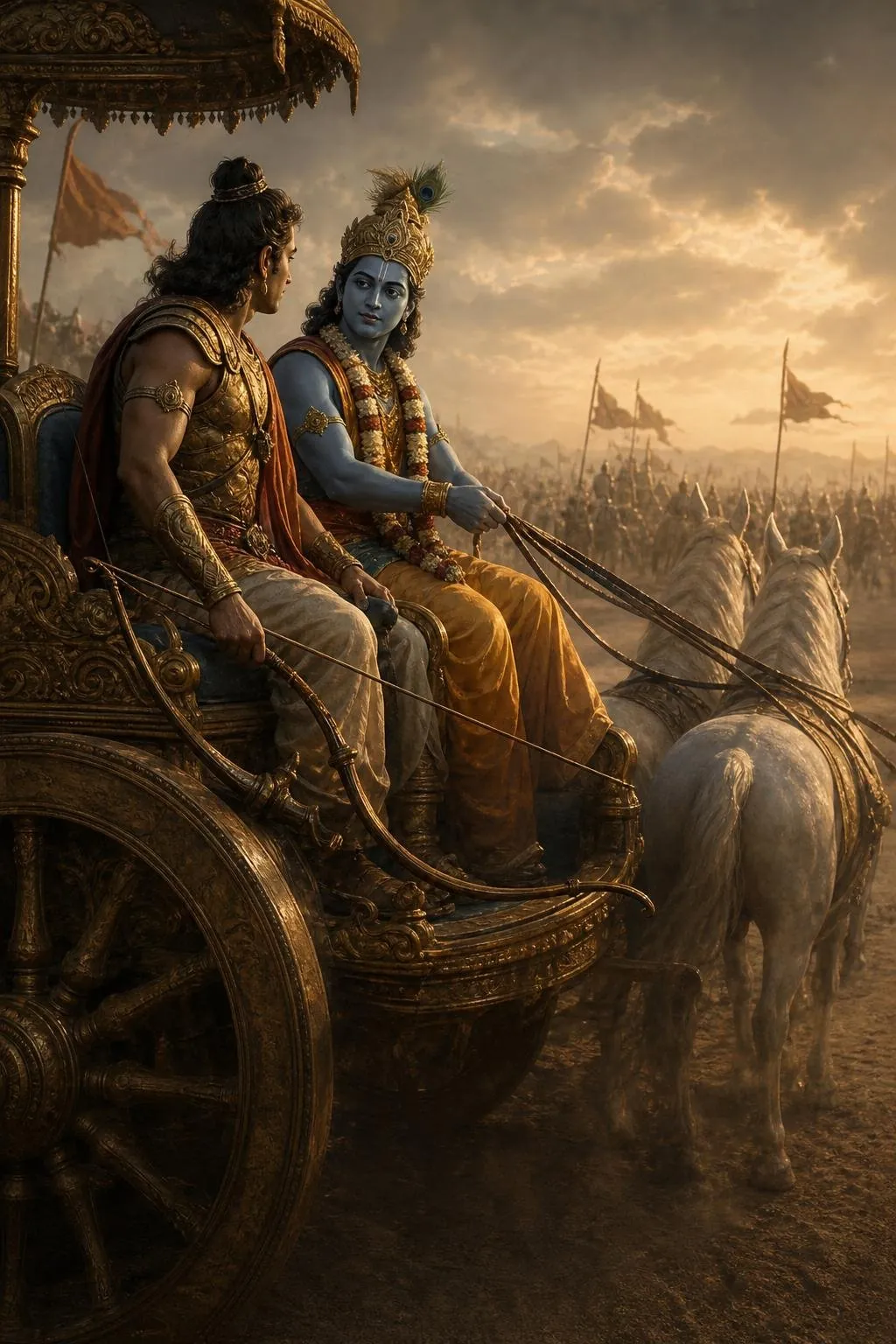
A film for every verse

A short film on each verse: first the Sanskrit chant, then where it comes in the story, then the meaning in plain words. New films are added all the time.

In your life

Every verse says what it means for your mind, your family and your work, and gives you one small thing to try today.
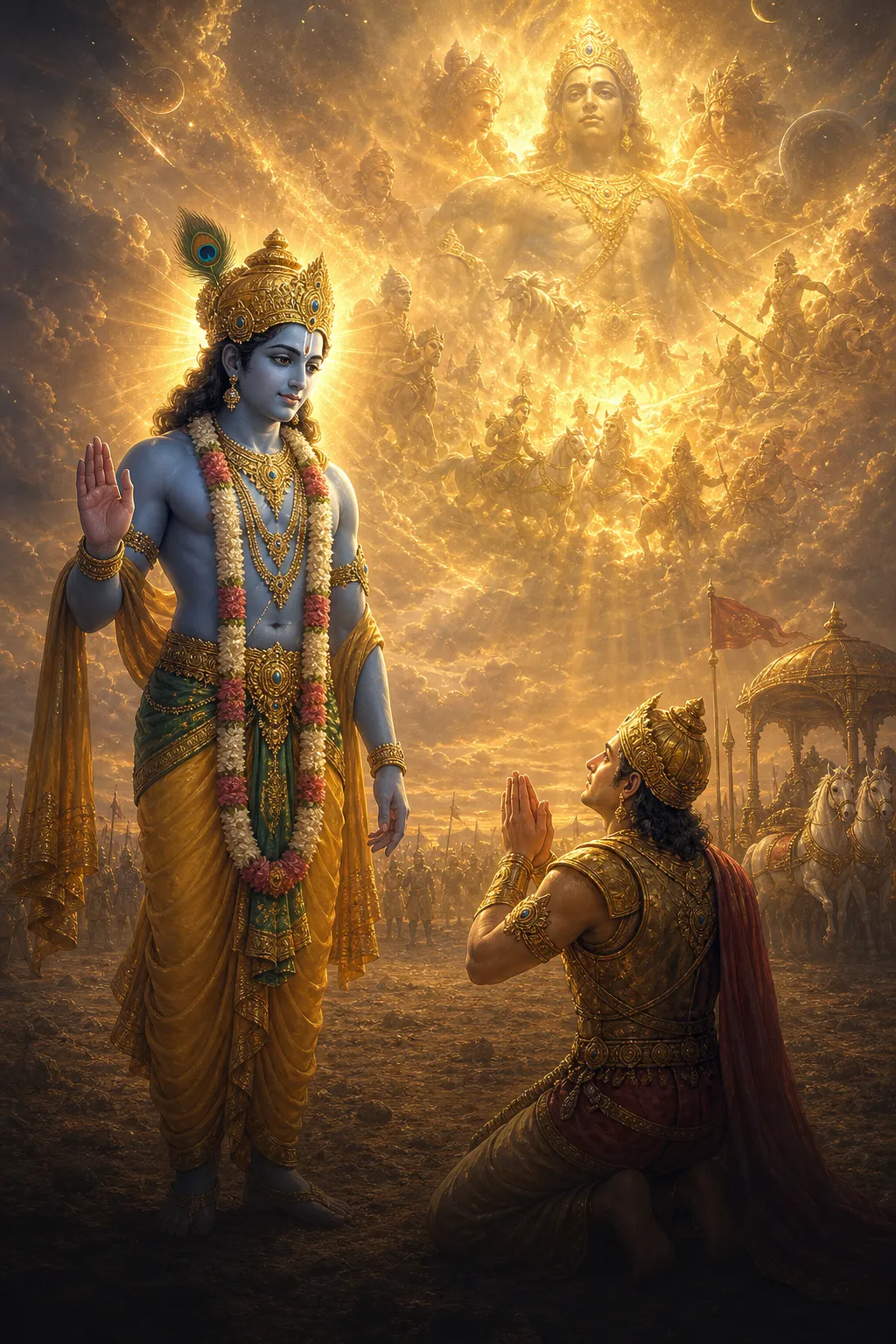
Ask Krishna

Ask what is on your mind, by typing or speaking. The answer comes with the verses it is drawn from.